

Sustainable Fashion for Women Over 40: 2026 Guide
Table of Contents
- Why Sustainable Fashion for Women Over 40 Is Different
- Natural Fibers That Make Sense for Midlife Comfort and Style
- How to Build a Sustainable Wardrobe Without Starting Over
- The Capsule Wardrobe for Women Over 40: Fewer Pieces, More Wear
- Ethical Business Casual for Women: Workwear That Works Harder
- How to Spot Greenwashing Before You Buy
- Care, Repair, and Circular Fashion: Making Clothes Last
- Frequently Asked Questions
Last Updated: September 23, 2026
Why Sustainable Fashion for Women Over 40 Is Different
Sustainable fashion for women over 40 is the practice of choosing well-made, responsibly sourced clothing that fits a changing body, a busier schedule, and a longer-term view of what a wardrobe is for. At Sānvivá, we see this shift constantly: women in their forties and fifties are not shopping for trends, they are shopping for pieces that will still work in three years. That is a fundamentally different brief from fast fashion, and it changes what you should buy.
Most guides treat sustainability as a moral question. For this age group it is a practical one. Bodies change. Work changes. The clothes that suited you at 32 often do not suit you at 45, and replacing them every season is both expensive and wasteful. The goal here is fewer, better pieces that adapt.
Below, we break down the fabrics, the capsule structure, and the greenwashing traps that matter most. The five sections that follow cover everything from fibre choice to repair.
Natural Fibers That Make Sense for Midlife Comfort and Style
Natural fibres win on comfort first, and comfort is what keeps clothes in rotation. Organic cotton, linen, merino wool, hemp, and Tencel each behave differently against skin that is more sensitive to heat and synthetic cling than it was a decade ago.
A common mistake is buying "sustainable" fabric without checking the blend. A garment labelled "cotton" can be 60% polyester. Check the composition tag before anything else.
- Organic cotton: breathable, holds shape, easy to wash. Best for shirts and basics.
- Linen: the most breathable option in heat, softens with every wash, creases by design.
- Merino wool: temperature-regulating and odour-resistant, so it needs washing less often.
- Hemp: durable and gets softer over time, good for structured pieces.
- Tencel: a wood-pulp fibre with a smooth drape, useful for workwear that needs to look polished.
For layering across a fluctuating body temperature, a soft turtleneck sweater in a cotton-acrylic knit or an oversized knit cardigan in a breathable knit does more work than three trend pieces.

How to Build a Sustainable Wardrobe Without Starting Over
Building a sustainable wardrobe does not require throwing out what you own. The fastest route is to audit what you already wear, identify the gaps, and fill only those gaps with better-made pieces.
Start with a two-week wear log. Note every item you actually put on. Most women find they wear roughly a fifth of their wardrobe on repeat. That is your real baseline, and everything else is either a gap or clutter.
Then sort what is left into three piles:
- Keep: worn regularly, fits well, still in good condition
- Repair: good quality but damaged (hem, seam, button)
- Release: does not fit, does not suit, or has not been worn in a year
Only after that do you buy. When you do, buy the piece that fills a genuine gap, in a natural fibre, in a colour that works with at least three other things you own. That single rule prevents most impulse purchases.
The Capsule Wardrobe for Women Over 40: Fewer Pieces, More Wear
A capsule wardrobe for women over 40 is a small set of interchangeable pieces, usually 25 to 40 items including shoes, chosen so that most combinations work together. The point is not minimalism for its own sake. It is that every piece earns its place, so you spend less time deciding and less money replacing.
Women's Oversized Cotton Button-Up →
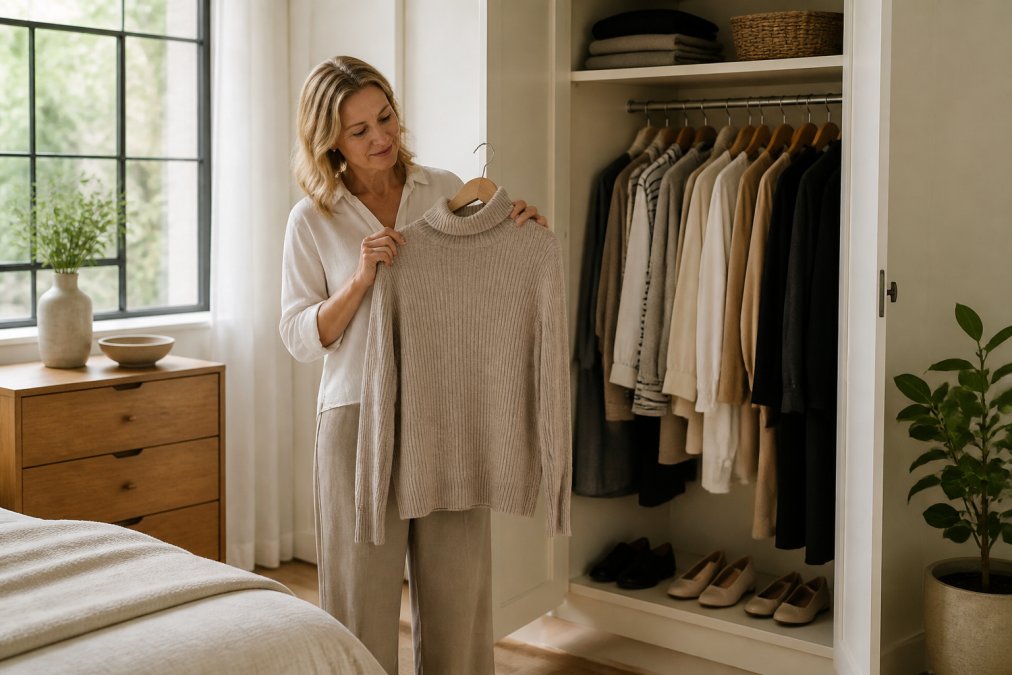
Most capsule guides are written for a 28-year-old body that does not run hot at 3 p.m. and cold at 7 p.m.
| Capsule Slot | How Many | Midlife-Specific Examples |
|---|---|---|
| Tops | 5 | Cotton shirt, fine-knit pullover, mock-neck, two tees with a relaxed armhole |
| Bottoms | 4 | Straight-leg trousers with a comfort waistband, dark jeans with 2% stretch, midi skirt, tailored shorts |
| Layers | 3 | Open-front cardigan, unstructured blazer, fine merino knit |
| Shoes | 2 | Cushioned everyday flat, low block heel |
| Outerwear | 1 | Coat that fits over a thick knit without pulling at the shoulder |
Ethical Business Casual for Women: Workwear That Works Harder
Ethical business casual means workwear made by companies that can show where and how the garment was produced, in fabrics that hold up to repeated wear. For women splitting time between an office, a home desk, and the school run, the practical test is whether a piece survives all three without a change of clothes.
How to Spot Greenwashing Before You Buy
Greenwashing is marketing that makes a garment sound environmentally responsible without any verifiable change to how it was made. It is common, and it is designed to be hard to spot.
Run every purchase through these checks:
- Is there a certification? Look for recognised textile standards, not a brand's own logo.
- Is the fibre percentage stated? "Made with organic cotton" is meaningless without a number.
- Is there a named factory or region? Transparency means specifics.
- Does the brand sell a new "sustainable" collection every month? Volume and sustainability pull in opposite directions.
- Is the green claim on the product page or only in the campaign? Marketing copy is not a materials disclosure.
Care, Repair, and Circular Fashion: Making Clothes Last
The most sustainable garment is the one you already own, worn for longer. Extending a piece's life by even a year or two avoids the water, energy, and fibre that a replacement would cost, and it is the cheapest sustainability move available to you. Most guides stop at "wash less." This section goes further into repair, tailoring, and the circular platforms that actually work for midlife wardrobes.
A simple repair and circular routine looks like this:
- Monthly: check hems, buttons, and seams on the five pieces you wear most.
- Seasonally: de-pill knits, re-block wool, and polish shoes.
- Before buying new: search resale platforms for the exact piece you want, in your measurements.
- Before donating: ask whether a tailor or a repair service could give the piece another two years.
Frequently Asked Questions
What is the 3-3-3 rule for clothing?
The 3-3-3 rule is a packing and wardrobe shortcut: three tops, three bottoms, and three pairs of shoes can be mixed into nine different outfits. For sustainable fashion for women over 40, it works as a capsule starter. Pick three natural-fiber tops, three bottoms that fit well now, and three comfortable shoes. Because every piece coordinates with every other, you buy less and wear more, which is the core of intentional shopping.
How do I transition to a sustainable wardrobe after 40?
Transition gradually instead of replacing everything at once. Start by tracking what you actually wear for two weeks, then remove anything that no longer fits or feels comfortable. Fill the gaps with pieces that work across multiple outfits, such as an oversized cotton button-up shirt or a soft turtleneck sweater. Add second-hand or circular fashion finds where you can, and repair what you already own before buying new.
What fabrics are best for sustainable fashion?
Natural fibers such as organic cotton, linen, merino wool, hemp, and Tencel tend to last longer and breathe better than synthetic blends. For midlife comfort, look for cotton and wool blends that hold their shape through repeated washing. Check the care label too: a garment you can wash gently and wear for years has a lower cost-per-wear than a cheaper piece that pills after three washes.
Where should 40-year-old women shop for clothes?
Look for retailers that explain their materials and supply chain rather than just using green imagery. Prioritize stores that stock natural-fiber basics in a range of sizes and offer clear returns. Sānvivá carries vetted womenswear like the oversized cotton button-up shirt ($48.85) and the soft turtleneck sweater ($35.92), so you can build a capsule wardrobe without multiple checkouts or guessing at quality.
How can I tell if a brand is greenwashing?
Greenwashing usually shows up as vague claims. Watch for phrases like 'eco-friendly' with no fiber details, or 'sustainable collection' that never names the material. Real transparency means specific facts: organic cotton, linen, merino wool, where the garment was made, and how to care for it. If a brand cannot tell you what a piece is made of and where it came from, treat the green label as marketing.
Is sustainable fashion more expensive than fast fashion?
The upfront price is often higher, but cost-per-wear tells a different story. A $35.92 soft turtleneck sweater worn twice a week for two winters costs far less per wear than a cheap top that loses shape after five washes. Building a capsule wardrobe of quality over quantity reduces how often you replace basics, which lowers your yearly clothing spend and keeps textile waste out of landfill.