

Tips for Buying Quality Wigs Online: 2026 Guide
Table of Contents
- How to Measure Your Head for a Wig Before You Buy
- Wig Cap Construction Types: Lace Front, Monofilament, and More
- Human Hair vs Synthetic Wigs: Which Lasts Longer?
- Density, Lace, and Hairline: What Separates Good Wigs from Bad Ones
- Return Policies, Hygiene, and Allergy Checks: The Fine Print Nobody Reads
- Caring for Your Wig So It Keeps Its Quality
- Frequently Asked Questions
Last Updated: September 12, 2026
How to Measure Your Head for a Wig Before You Buy
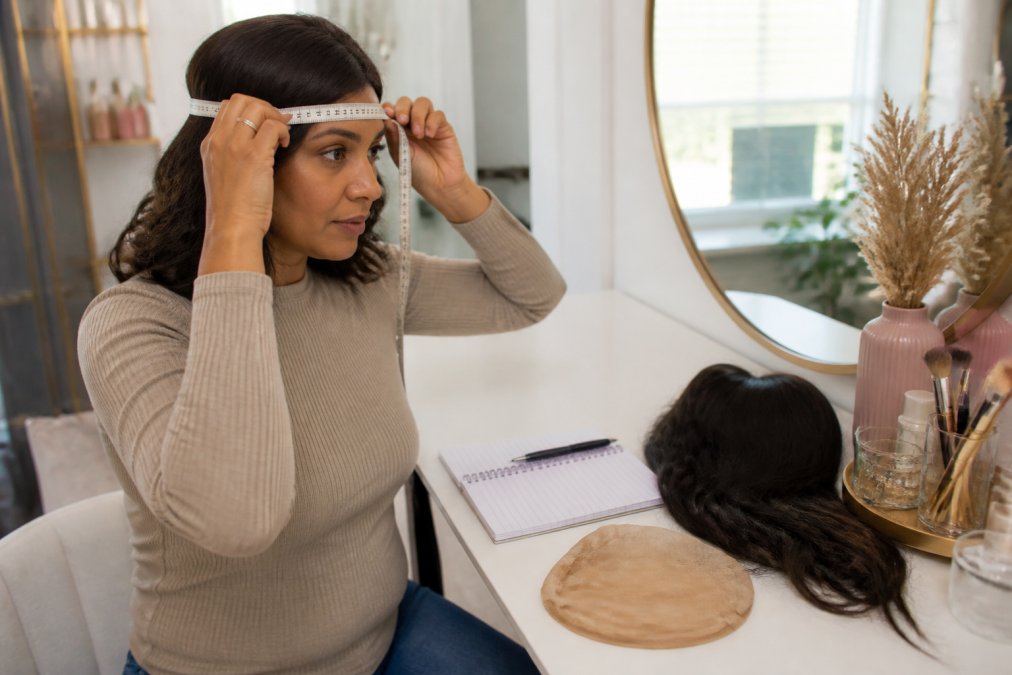
Most wig disappointments trace back to one avoidable mistake: buying quality wigs before measuring. Five minutes of measuring prevents the slipping, pinching, and unnatural hairlines that send people back to the returns queue.
Wig sizing is the practice of matching a cap's circumference, front-to-back length, and ear-to-ear width to your own head so the unit sits flat and stays put. A cap that's too large rides up at the nape; one that's too small causes headaches and tension along the hairline.
The Four Measurements That Matter Most
You'll need a soft measuring tape and a helper for the back-of-head readings:
- Circumference: Run the tape around your hairline, behind your ears, and around the nape.
- Front to back: Measure from your natural hairline at the forehead over the crown to the nape.
- Ear to ear (across the forehead): Start at one temple, arc across the front hairline, and finish at the other temple.
- Ear to ear (over the crown): Measure from the top of one ear, over the crown, to the top of the other ear.
Write these down before you shop. Most cap sizes fall into petite, average, and large brackets based on circumference, so trust vendors that publish a clear size chart.
Wig Cap Construction Types: Lace Front, Monofilament, and More
Cap construction is the biggest factor in how natural a wig looks and how comfortably it wears. Knowing the main types saves you from paying for features you don't need.
| Construction | Best For | Scalp Appearance | Breathability |
|---|---|---|---|
| Lace front | Natural front hairline | Realistic at the part line | Good |
| Monofilament | Versatile parting | Skin-like where you part | Moderate |
| Hand-tied | Comfort and movement | Soft, natural flow | High |
| Wefted | Budget everyday wear | Less realistic at the part | Good |
A lace front places fine lace along the forehead so hair appears to grow from your scalp. Monofilament caps use a sheer mesh that lets you part anywhere. Hand-tied construction knots individual strands for a softer drape. Wefted caps are machine-sewn strips, durable and affordable but less convincing at a visible part. If you wear your hair up, prioritise lace or monofilament; under a hat, wefted does the job for less.
Lace Front vs. Lace Closure vs. Full Lace
"Lace front" is often used loosely, but the three configurations differ:
- Lace front: Lace runs ear-to-ear across the forehead, about one to two inches deep. You get a natural hairline and can part slightly off-center, but the crown and back are typically wefted, so a deep part or high ponytail exposes the tracks.
- Lace closure: A smaller lace piece (usually 4x4 or 5x5 inches) sits at the crown or parting area, giving a realistic part but no front hairline, often worn under a hat, scarf, or with a leave-out.
- Full lace: Lace covers the entire cap, allowing any part or style, including a high bun. It's the most expensive and delicate; the lace can tear if handled roughly.
For maximum styling freedom, full lace is the answer. If you mainly wear your hair down or in low styles, a lace front gives you 90% of the look for a fraction of the price.
Lace Grades: HD, Transparent, and Standard
Lace type determines how invisible the front edge is:
- Standard lace: The most common and affordable. Slightly thicker, and can be visible against very light or very deep skin tones unless tinted with foundation or lace tint spray.
- Transparent lace: Finer and softer than standard, blends across more skin tones, with smaller knots. A mid-range upgrade.
- HD lace: The thinnest and most undetectable, designed to melt into the skin. Also the most fragile, it tears easily during install and removal, and lasts fewer installs than standard lace.
HD lace commands a premium but may not be worth it if you're rough on your wigs or reinstall frequently. For daily wear, transparent lace often hits the best balance of realism and durability.

Knotting: Bleached, Unbleached, and Pre-Plucked
Knotting affects realism and prep work:
- Unbleached knots: Dark and visible against the scalp; you'll need to bleach or conceal them with makeup.
- Bleached knots: Lightened to blend with the scalp. More natural out of the box but weakens the knot, so the hairline sheds faster with rough handling.
- Pre-plucked hairline: Thinned and shaped to look like natural growth. Saves customization time, but quality varies, some units are over-plucked and look sparse.
How Construction Affects Styling and Longevity
Construction also dictates styling and longevity:
- Wefted caps are the most durable and easiest to maintain, but limit you to styles that cover the tracks. Ideal for beginners and everyday wear.
- Lace front and closure caps need gentle handling around the lace. Avoid pulling the lace when brushing, and never scrub the knots. With care, a good lace front lasts multiple installs.
- Full lace and hand-tied caps offer the most natural movement and flexibility but are the most fragile, requiring careful washing, low heat, and storage on a stand.
Human Hair vs Synthetic Wigs: Which Lasts Longer?
Human hair wigs generally outlast synthetic ones because the strands tolerate heat styling, colouring, and repeated washing. A well-cared-for human hair unit can stay wearable for a year or more, while a heat-friendly synthetic blend holds its look for a shorter stretch before the fibres dull and tangle.
The trade-off isn't just lifespan:
- Human hair (including remy and virgin hair): Styles with heat tools, takes colour, feels soft, costs more, needs real maintenance.
- Synthetic: Holds a pre-set style, resists humidity, costs less, but can't take high heat and shows wear sooner.
- Synthetic blend: Middle ground, moderate price, decent texture, limited heat tolerance.
Remy hair keeps its cuticles aligned in one direction, which reduces tangling; virgin hair has never been chemically processed, so it behaves most like your own. Both are worth the premium if you style frequently. For occasional low-effort wear, a quality synthetic is the smarter spend.
Why Human Hair Lasts Longer: The Mechanism
The longevity difference comes down to fibre structure. Human hair has a cuticle layer that can be lifted, moisturised, and sealed repeatedly (PubMed). Synthetic fibres are plastic filaments, heat-set once at the factory, but repeated heat and friction roughen the surface, causing tangling, dullness, and that "frizzy" look. Human hair can be deep-conditioned and trimmed to extend its life; synthetic cannot be repaired once degraded.
"Lasts longer" still depends on care: a human hair wig washed with harsh shampoo, brushed roughly, and stored in a drawer degrades faster than a gently treated synthetic. The fibre sets the ceiling; your routine determines how close you get.
How to Verify "Human Hair" Claims Online
Online buying gets risky here: some listings claim "human hair" when the unit is a blend or heavily processed to mimic human texture. Check before you buy:
- Ask for a burn test video: Human hair burns to ash and smells like burnt hair; synthetic melts into a hard bead and smells like plastic (PubMed). Reputable vendors provide this on request.
- Look for cuticle direction: Remy human hair should have all cuticles aligned. If the vendor can't confirm remy or virgin, assume non-remy, which tangles faster.
- Check weight and density claims: Human hair is heavier than synthetic for the same volume. A listing claiming 250% density at a suspiciously low price is likely a blend or lower-grade fibre.
- Read the fine print on "human hair blend": Some vendors mean as little as 30% human hair. If the percentage isn't stated, ask.
- Request a video call or live photo: A confident vendor will show the unit on camera, lace, knots, and hair in natural light, and answer colour-matching and texture questions.
Matching Fibre to Your Lifestyle
- Frequent styling, heat tools, colour changes: Human hair is the only option that won't degrade quickly. Budget for the higher upfront cost and maintenance products.
- Occasional wear, pre-set styles, humidity resistance: A quality synthetic holds its shape with almost no effort and costs far less. Avoid heat tools unless the fibre is explicitly heat-friendly.
- Daily wear on a budget: A synthetic blend can work, but expect to replace it sooner. Rotating two units extends the life of each.
- Sensitive scalp or medical hair loss: Human hair is generally gentler, but check for adhesive and fibre sensitivities. Some synthetic fibres and lace glues irritate sensitive skin, so patch-test first.
Density, Lace, and Hairline: What Separates Good Wigs from Bad Ones
Three specifications reveal more about quality than any marketing photo: density, lace type, and hairline finish.
Density describes how much hair is packed onto the cap, measured as a percentage, and higher isn't automatically better. A 250% density unit gives dramatic volume but can look heavy on a small face; mid-range density often reads more natural for daily wear. Match the thickness of healthy natural hair rather than chasing the highest number.
Lace type determines how invisible the front edge is. HD lace is finer and blends across more skin tones than standard lace, which is why it costs more. Check that the lace matches your scalp tone, not just the hair colour.

Hairline finish is where budget units give themselves away. Pre-plucked hairlines with baby hairs look far more convincing than a blunt, dense edge. If photos show a hard line across the forehead, expect to do significant customisation yourself.
Return Policies, Hygiene, and Allergy Checks: The Fine Print Nobody Reads
Return terms are where online wig shopping gets genuinely risky, and most buyers never check them until something goes wrong. Because wigs are hygiene-sensitive, many sellers restrict returns to unworn, unaltered items in original packaging. Once you've cut lace, plucked a hairline, or worn the unit, your return window is often closed.
Before buying quality wigs, confirm four things:
- Is the return window stated in days, and does it start at delivery or dispatch?
- Are worn or altered wigs excluded, and is that exclusion clearly written?
- Is there a restocking fee, and who pays return shipping?
- Does the policy mention hygiene seals or tags that must stay attached?
Allergy and scalp sensitivity deserve the same scrutiny. Some people react to adhesives, lace glues, or certain synthetic fibres (PubMed). If you have a known sensitivity, ask about fibre composition and adhesive ingredients before ordering, and patch-test any glue on your inner wrist first. A vendor that answers these questions clearly stands behind its stock.
Caring for Your Wig So It Keeps Its Quality
A good wig rewards careful maintenance, and the routine is simpler than most people expect. Detangle before washing, use cool water with a gentle shampoo, and condition mid-length to ends rather than the cap. Never scrub the lace or knots.
For human hair, air-dry on a wig stand and apply low heat only when needed; for synthetic, skip heat tools unless the fibre is explicitly heat-friendly. Store your wig on a stand or in a satin bag to hold its shape, and rotate units if you wear one daily. A wig grip or nylon wig cap underneath protects your natural hair and the cap, keeping the fit secure and the lace clean.

At Sānvivá, we stock the everyday essentials that make this routine easy, including a nylon wig cap multi-pack that keeps your natural hair flat and your install smooth.
Buying a quality wig online comes down to the unglamorous work first: measuring properly, reading the cap construction, checking return terms, and confirming the fibre before you commit. That's where most shoppers lose money, and it's exactly where Sānvivá tries to make things easier. Our curated collection brings wigs, jewelry, and everyday apparel together in one place, with quality-vetted pieces and a single checkout instead of five. Explore our HD lace front human hair wigs and get started with Sānvivá to find a unit that fits, lasts, and looks like it was made for you.
Frequently Asked Questions
How do I measure my head for an online wig purchase?
Use a soft measuring tape and take four measurements: circumference (around your hairline and nape), ear-to-ear across the top, front hairline to nape, and temple to temple. Write each one down and compare against the brand's size chart before ordering. If you fall between sizes, size up. A wig that is slightly too large can be adjusted with straps or a wig grip, but one that is too tight will cause headaches and slippage. Measuring takes five minutes and saves the hassle of a return.
What should I look for when buying a wig for the first time?
Start with cap construction, fiber type, and density. A lace front gives you a natural-looking hairline, while a basic cap works for casual wear. Human hair costs more but lasts longer and takes heat styling. Check the density rating: 130% to 150% looks natural for everyday wear, while 200% and above gives volume. Also read the return policy carefully. A wig that cannot be returned or exchanged is a risky first purchase.
Is it better to buy a wig at a store or online?
Online shopping gives you more color options, fiber choices, and price points than most physical stores carry. The trade-off is that you cannot touch the hair or try the cap before buying. To reduce risk, look for retailers that offer video consultations, detailed color swatches, and clear return policies. Buying online also lets you compare specs side by side, which is harder to do in person. If a site offers none of these safeguards, that is a red flag.
How can I tell if a wig is good quality before it arrives?
Look for specific details in the product listing: lace type (HD lace is thinner and blends better), density percentage, cap construction method (hand-tied versus machine-wefted), and whether the hair is remy or virgin. High-quality listings show close-up photos of the hairline, the inside of the cap, and the hair under different lighting. If a listing uses only stock images, has vague descriptions like premium quality with no specs, or shows no return policy, proceed with caution.
What are the red flags when buying wigs online?
Watch for listings with no return policy or a hygiene clause that blocks all returns once the seal is broken. Be cautious of prices that are far below market rate for human hair, vague fiber descriptions that do not specify human or synthetic, and no option for a video consultation. Also check whether the site lists the hair origin. Reputable sellers tell you where the hair comes from and how it was processed. If you cannot find basic specs, the wig is a gamble.
How do I care for a wig to keep it looking new?
Wash your wig every 8 to 10 wears using sulfate-free shampoo and cool water. Detangle gently with a wide-tooth comb starting from the ends and working up. Air-dry on a wig stand, never on a radiator or in direct sun. For human hair wigs, use heat protectant before styling tools. Store on a stand or in a satin bag to prevent tangling. A maintenance routine like this keeps the fibers smooth and extends the life of your wig by months.