

How to Maintain Jewelry Quality Online: 2026 Guide
Table of Contents
- How to Tell If Jewelry Is High Quality
- How to Clean Jewelry at Home Without Damage
- Best Practices for Jewelry Storage
- How to Maintain Jewelry Quality Online: Daily Care Habits
- Material-Specific Longevity: Gold, Silver, Diamonds, and Plated Pieces
- Sustainable and Eco-Friendly Jewelry Care
- When to See a Professional: Insurance, Appraisals, and Inspections
- Frequently Asked Questions
Last Updated: September 14, 2026
How to Tell If Jewelry Is High Quality
Learning how to maintain jewelry quality starts at the product page, not the polishing cloth. No cleaning routine can rescue a plated alloy that was never built to last, so vet pieces at checkout.
At Sānvivá, we curate jewelry alongside womenswear, kids wear, wigs, and everyday essentials, so we see a lot of listings. Quality shows up in the details a seller publishes: close-up photos of the clasp, hallmark stamp, and stone settings.
Fine jewelry means solid precious metals and genuine gemstones, not plated or costume pieces on a base metal core. That distinction drives every care decision.
Online Clues: Photos, Descriptions, and Return Policies
Three things separate a trustworthy listing from a risky one:
- Metal disclosure: "14k gold" or "sterling silver" names a solid material. "Gold-tone" or "gold-plated" means a thin layer over base metal.
- Weight and dimensions: Gram weights and millimetre measurements reveal whether a chain is substantial or flimsy.
- Return terms: A clear return window shows the seller expects the piece to satisfy you in person.
The U.S. Federal Trade Commission guidance on jewelry marketing requires sellers to disclose plated and filled metals accurately, so vague metal claims are a genuine red flag rather than a stylistic choice.
How to Clean Jewelry at Home Without Damage
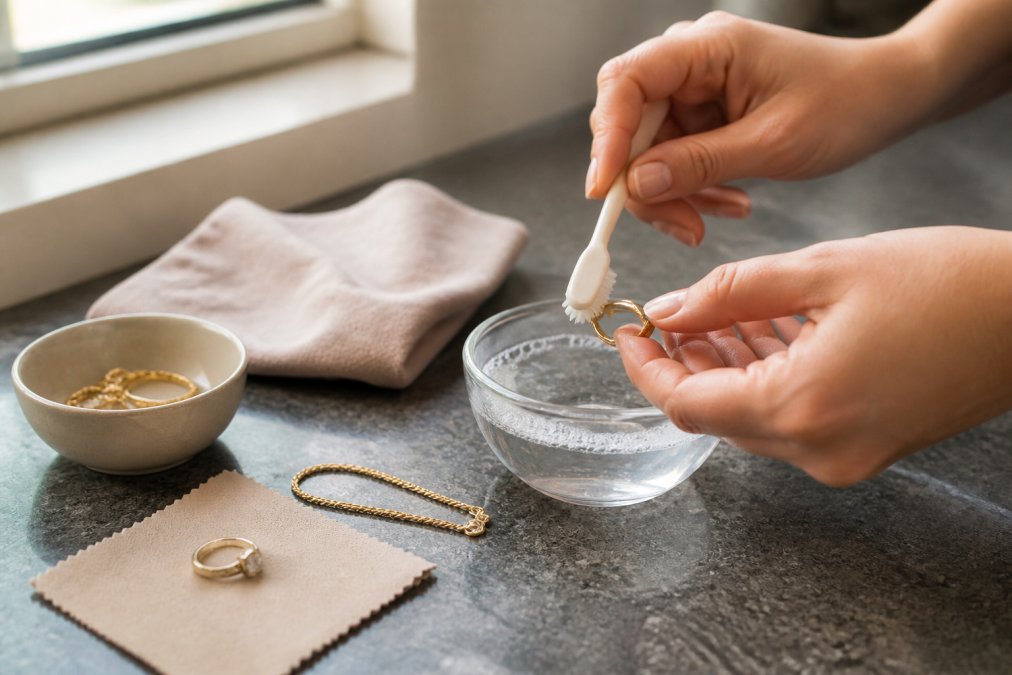
Most jewelry cleans safely at home with warm water, mild dish soap, and a soft-bristled brush. Damage happens with the wrong tool: abrasive toothpaste, harsh household cleaner, or an ultrasonic cleaner used on the wrong stone.
Here is the standard method that works for solid gold, sterling silver, and most diamond pieces:
- Fill a small bowl with warm water and a drop of mild dish soap.
- Soak the piece for 10 to 15 minutes to loosen buildup.
- Gently scrub with a soft-bristled brush, working around the gemstone setting rather than across it.
- Rinse under warm running water with the drain closed, or over a fine strainer.
- Pat dry with a polishing cloth and let the piece air dry fully before storing.
Safe Cleaning Methods by Material
| Material | Safe Method | Avoid |
|---|---|---|
| Solid gold | Warm water, mild dish soap, soft brush | Chlorine, abrasive creams |
| Sterling silver | Soapy water, silver polishing cloth | Harsh dips on antique patina |
| Diamonds | Soapy water, soft brush | Ultrasonic on fracture-filled stones |
| Pearls and porous stones | Damp soft cloth only | Soaking, soap, ultrasonic |
| Plated and vermeil pieces | Dry soft cloth, minimal water | Scrubbing, repeated soaking |
Best Practices for Jewelry Storage
Dry, separated, and away from air. Oxidation and tarnish accelerate with moisture and airborne chemicals, so storage matters as much as cleaning.
A Smithsonian Institution guide to caring for jewelry and metalwork recommends storing each piece separately in a dry environment, because metals and stones can scratch one another when they touch. That single habit prevents most tangling, scratching, and chain breakage.
Practical storage rules:
- Keep pieces in individual soft pouches or resealable bags to limit air exposure.
- Hang necklaces on hooks rather than coiling them in a pile.
- Store silver in tarnish-resistant bags or a lined box.
- Keep jewelry away from bathrooms, where humidity stays high.
Travel-Specific Maintenance
Travel is where most jewelry damage happens: a loose necklace knots, and rings left on a hotel sink lose stones.
A dedicated Travel Jewelry Organizer Case - PU Leather Storage Box solves both problems: a compact PU leather shell with a soft velvet interior and separate compartments that hold earrings, necklaces, and rings apart. For longer trips, Resealable Jewelry Storage Bags in sizes from 4x6cm up to 12x17cm keep individual pieces sealed against humidity and tangle-free in a suitcase.


How to Maintain Jewelry Quality Online: Daily Care Habits
Daily habits do more for jewelry longevity than any deep clean: reduce chemical exposure and remove pieces before they take a knock.
Build a routine around the moments you already have:
- Last on, first off. Put jewelry on after perfume, lotion, and hairspray have dried, and take it off before bed.
- Remove before chores. Cleaning products, bleach, and hot water all degrade plating and dull luster.
- Wipe after wear. A quick pass with a dry soft cloth removes skin oils and residue before they set.
- Check backs and clasps weekly. A loose fitting is the leading cause of lost earrings.
Rubber Earring Backs (100-Pack) - Secure Earring Stoppers hold studs firmly, reduce irritation from metal backings, and cost little enough to keep a spare pair in every bag.

Material-Specific Longevity: Gold, Silver, Diamonds, and Plated Pieces
Different materials age on different timelines. The table below maps each common material against the everyday environments that damage it, so you can predict wear instead of reacting to it.
Material Reaction Chart: What Each Metal and Stone Hates
| Material | Chlorine / Pools | Salt Water | Perfume & Lotion | Humidity & Air | Sunlight |
|---|---|---|---|---|---|
| 24k gold | Dulls surface | No effect | Residue film | No effect | No effect |
| 14k-18k gold | Attacks alloy, pits over time | Accelerates alloy wear | Residue film, dulls luster | No effect | No effect |
| Sterling silver | Accelerates tarnish | Accelerates tarnish | Speeds tarnish | Tarnishes in weeks | Mild tarnish |
| Platinum | No effect | No effect | Residue film | No effect | No effect |
| Diamonds | No effect on stone | No effect on stone | Dulls brilliance | No effect | No effect |
| Pearls | Destroys nacre | Destroys nacre | Etches surface | Cracks from dryness | Fades colour |
| Opals & porous stones | Cracks, clouds | Cracks, clouds | Stains | Cracks from dryness | Fades colour |
| Plated / vermeil | Wears through layer fast | Wears through layer fast | Wears through layer | Tarnishes base metal | Fades plating |
Read the chart by column, not by row. If your life includes a pool, a gym, or a humid climate, that column tells you which pieces to remove first.
How Each Material Ages Over Time
Karat gold is measured by purity: 24k is pure, while 14k and 18k mix gold with harder alloys for durability and scratch resistance. Higher karat means richer colour but a softer surface, so 18k rings wear faster than 14k in daily rotation.
Sterling silver is 92.5% silver, and the remaining alloy is what tarnishes. Left in open air, it darkens within weeks in humid climates; sealed storage slows that. It is also the most repairable common metal.
Platinum is denser and more scratch-resistant than gold, developing a matte patina rather than losing metal. It costs more upfront but rarely needs re-plating.
Diamonds are the hardest natural material but not indestructible: they can chip, and a gemstone setting loosens over years of wear. A maintenance schedule beats reacting to a missing stone, since smaller prongs need more frequent inspection.
Pearls and porous stones are the opposite of diamonds: soft, they absorb whatever touches them and cannot be polished back to new. Damp-cloth-only care is the only safe option.
Plated and vermeil pieces have the shortest lifespan by design. The layer wears at points of friction: the inside of a ring, the clasp of a chain, the post of an earring. Vermeil is thicker, so it lasts longer, but the failure mode is the same.
Care Frequency by Material
| Material | Typical Care Frequency | Main Threat |
|---|---|---|
| 14k-18k gold | Wipe weekly, clean monthly | Chlorine, scratches |
| Sterling silver | Polish every 2-4 weeks | Tarnish, humidity |
| Platinum | Wipe weekly, polish every 2-3 months | Patina buildup |
| Diamonds | Clean monthly, check prongs quarterly | Loose settings, chips |
| Plated / vermeil | Dry wipe after each wear | Wearing through the layer |
| Pearls | Damp cloth after wear | Soap, perfume, dryness |
| Opals & porous stones | Damp cloth, never soak | Cracking, staining |
Sustainable and Eco-Friendly Jewelry Care
The most sustainable jewelry care is the care that keeps you from replacing things. Extending a piece you own avoids the mining, refining, and shipping a new one requires, and usually costs less than a replacement.
A few habits do most of the work:
- Swap single-use polishing wipes for a washable microfiber polishing cloth.
- Use a refillable mild soap rather than aerosol or solvent cleaners.
- Repair before you replace. A re-tipped prong or a new clasp is a small cost against a new piece.
- Choose solid precious metals over plated when buying, since they can be repaired indefinitely.
When to See a Professional: Insurance, Appraisals, and Inspections
Professional care is where the real money sits. An appraisal documents what a piece is worth, and an insurer generally will not cover jewelry without one. Maintenance records are part of that value story.
Why Maintenance Logs Matter for Insurance and Resale
A maintenance log is a simple record: date, piece, what was done, who did it. It takes a minute to write and changes two outcomes.
For insurance claims. A log showing regular inspections and cleanings supports the argument that the piece was well cared for, which matters for gradual damage, mysterious loss, or disputed condition. Photographs with dated service entries beat a receipt alone.
For resale value. A dealer or collector will pay more for a piece with documented care. A re-tipped prong with a dated receipt is evidence of maintenance; an undocumented piece of the same age is a question mark. The resale gap often exceeds the maintenance cost.
For estate and inheritance. When jewelry passes between generations, the appraisal and log travel with it. Without them, heirs undervalue pieces or lose track of what is real.
When to Get an Appraisal
Get an appraisal when you buy a significant piece, inherit one, or when metal prices have moved enough to change the value. Keep the paperwork with your policy, not in the jewelry box. Re-appraise every three to five years for pieces above your insurer's threshold.
What a Professional Inspection Actually Covers
Professional inspection is a separate, cheaper service. A jeweller checks prongs, clasps, and stone security under magnification, tightens what has loosened, and flags anything close to failing. Once a year suits pieces you wear often; more frequently for a daily-wear engagement ring.
A thorough inspection typically includes:
- Prong and bezel tightness on every stone
- Clasp and jump-ring integrity on chains and bracelets
- Solder joints and hinge wear on earrings and bracelets
- Surface condition of plated and vermeil pieces, to flag re-plating timing
- Stone-by-stone check on multi-stone pieces, where one loose setting is easy to miss
Repair Before Replacement
Then there is jewelry repair, which is the outcome of skipping all of the above. A re-tipped prong costs a fraction of replacing a lost diamond, and a re-soldered chain costs less than a new one. The Gemological Institute of America's guidance on jewelry care and identification is a useful reference for understanding what a professional is actually assessing.
Building Your Maintenance Log
You do not need software. A notebook, spreadsheet, or folder of photos works. What matters is that the record exists and is dated.
- Photograph every significant piece, front and back, when you acquire it.
- Note the appraisal date and value, and store it with your insurance policy.
- Log every cleaning, inspection, and repair with the date and the person who did it.
- Re-photograph after any repair, so the record reflects the current condition.
- Keep a copy off-site or in the cloud, not only in the jewelry box.
Frequently Asked Questions
What is the 2:1:1 rule for jewelry?
The 2:1:1 rule is a simple guideline for layering necklaces: two chains of the same length, one chain slightly longer, and one chain slightly shorter. This creates a balanced, layered look without tangling. For maintenance, it means you can wear multiple pieces together, but you should still clean and store them separately to avoid scratches. Following this rule helps you style your jewelry while keeping each piece in good condition.
How can you tell if jewelry is high quality before buying online?
Look for detailed product descriptions that specify materials like 14k gold, sterling silver, or genuine gemstones. Check for high-resolution photos from multiple angles, and read the return policy. Reviews mentioning durability and tarnish resistance are good signs. On Sānvivá, each piece is vetted for quality, so you can trust the descriptions. Avoid listings with vague terms like 'gold-tone' unless you're okay with plated jewelry that needs gentle care.
How do you prevent jewelry from tarnishing while in storage?
Store each piece in a dry, airtight container. Resealable jewelry storage bags or a lined jewelry box work well. Add anti-tarnish strips or silica gel packets to absorb moisture. Keep pieces separated to prevent scratches and tangling. For sterling silver, airtight bags are especially effective. Avoid storing jewelry in bathrooms where humidity speeds up tarnish. A consistent storage routine is one of the best practices for jewelry storage.
How often should you have your jewelry professionally inspected?
Once a year is a good rule for pieces you wear often, such as engagement rings or daily earrings. A jeweler can check for loose stones, worn prongs, and weak clasps. If you notice a stone feels loose or a clasp doesn't snap securely, go sooner. Regular inspections catch small issues before they become expensive repairs. For heirloom or high-value items, pair inspections with updated appraisals for insurance purposes.