

10 Essential Wig Care Tips for Beginners in 2026
Table of Contents
- 1. Wash Your Wig Less Often Than You Think
- 2. How to Wash Synthetic Wigs at Home Without Ruining the Fibers
- 3. How to Detangle a Wig Without Damaging It
- 4. Drying and Styling: The Step Most Beginners Rush
- 5. Heat Styling Precautions That Protect Your Investment
- 6. Storage That Prevents Matting and Frizz
- 7. Product Ingredients to Avoid (and What to Use Instead)
- 8. Repairing Damaged Fibers: What Actually Works
- Frequently Asked Questions
Last Updated: September 11, 2026
1. Wash Your Wig Less Often Than You Think
Most wig damage starts in the sink, not on your head, which is why these wig care tips begin with washing. Overwashing strips the oils that keep fibers soft, and beginners typically wash twice as often as they should. This guide from Sānvivá breaks down 10 essential wig care tips for beginners, starting with the schedule.
The most common mistake is treating a wig like your own hair. A wig doesn't produce natural oils, so every wash removes moisture it can't replace on its own.
Human Hair vs. Synthetic: Different Schedules
Washing frequency depends entirely on fiber type. Human hair wigs tolerate washing every 7-10 wears. Synthetic fiber wigs should go 10-15 wears between washes, sometimes longer.
Daily wear changes the math: a synthetic unit worn five days a week needs a wash roughly every two to three weeks, while human hair handles weekly washing without complaint.
Between washes, spot-clean the lace front and cap construction with a damp cloth. This removes scalp oils and product buildup without stressing the fibers.

2. How to Wash Synthetic Wigs at Home Without Ruining the Fibers
Learning how to wash synthetic wigs at home comes down to temperature, technique, and patience. Hot water is the enemy: anything above lukewarm relaxes the fibers and destroys the curl pattern.
Follow this sequence:
- Fill a basin with cool water and a capful of sulfate-free shampoo
- Submerge the wig and swish gently for 30 seconds. Never scrub or bunch the fibers
- Rinse in cool running water until it runs clear
- Apply leave-in conditioner from mid-length to ends, avoiding the cap
- Blot dry with a towel. Never wring or twist
The whole process takes about 10 minutes. Rushing the rinse leaves residue that attracts dust and causes matting within days.
Federal Trade Commission guidance on textile care labeling confirms that fiber content determines safe washing methods, which is why checking your wig's label before the first wash matters.
3. How to Detangle a Wig Without Damaging It
Detangling is where beginners do the most invisible damage. Yanking a wide-tooth comb through dry, curly fibers stretches and snaps them. The fix: always detangle wet, always start at the ends.
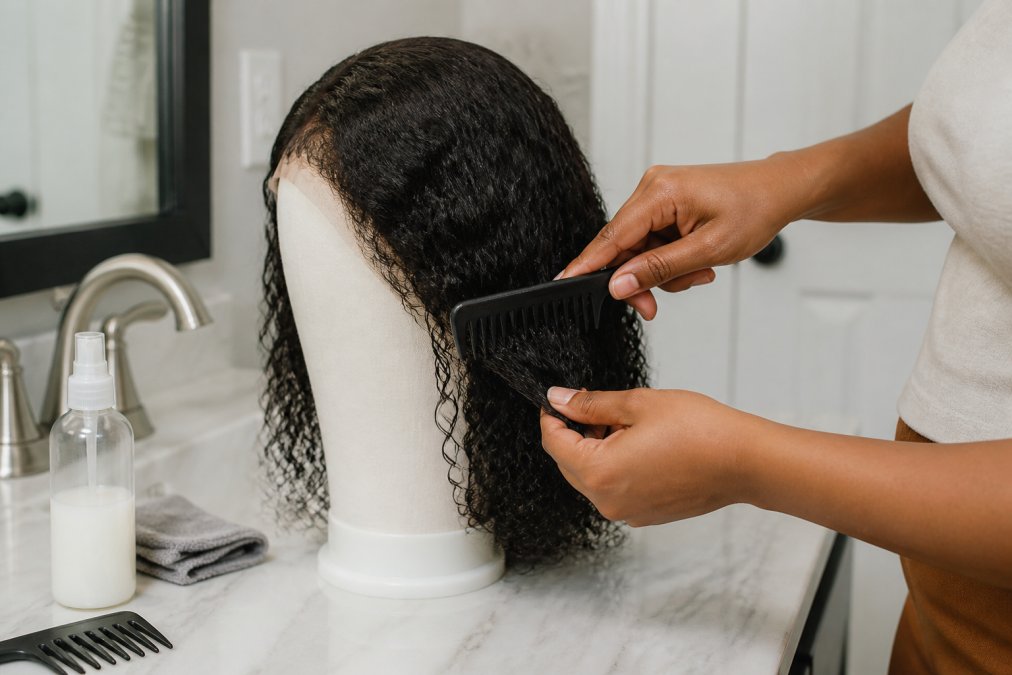
Work in small sections. Hold the fiber near the base with one hand and comb downward with the other. This keeps tension off the roots and prevents the cap from stretching.
Tools That Make Detangling Safer
A detangling brush with flexible bristles handles wavy and straight textures. A wide-tooth comb is the better choice for curly units like a Burmese curly HD lace wig, where bristles can separate the curl pattern.

Keep a spray bottle of water and leave-in conditioner nearby. Light misting lubricates the fibers so the comb glides instead of drags.
4. Drying and Styling: The Step Most Beginners Rush
Air drying is the safest method for any wig, human or synthetic. After blotting, place it on a wig stand or mannequin head and let it dry at room temperature, away from direct sunlight and radiators.
Never towel dry aggressively. Rubbing creates friction, and friction creates frizz. Squeeze water out in sections, then blot.
For synthetic units, a light mist of styling mousse restores shape as the fibers dry; human hair wigs benefit from a little leave-in conditioner on damp ends.
How often to wash a wig matters less than how you dry it. A wig that air dries properly lasts months longer than one blasted with a hairdryer.
5. Heat Styling Precautions That Protect Your Investment
Heat damage is the fastest way to destroy a wig. Synthetic fibers are thermoplastic: they soften and deform when heated, and once the curl pattern relaxes, it cannot be restored. Human hair behaves more like your own, but repeated high heat still strips moisture and weakens the cuticle.
Know Your Fiber's Heat Tolerance
Not all synthetic wigs are created equal. Standard fibers typically deform above 150°C (302°F), while heat-resistant synthetics withstand tools up to about 180°C (356°F) but still need caution. Always check the label for the maximum safe temperature; if no rating is given, assume the wig is not heat-safe.
Human hair wigs handle normal styling temperatures, but lower is always safer: most stylists recommend keeping tools below 180°C (356°F) to preserve softness and shine.
How to Test Heat Safety Before Styling
Before touching a hot tool to your wig, test a hidden section: part the hair at the nape or behind an ear and apply the tool to a small strand for two seconds. If the fiber crimps, sticks, or smells burnt, stop. If it glides smoothly and holds shape, proceed with caution.
Tool-by-Tool Guidelines
- Flat iron: Use the lowest setting. For synthetic wigs, never exceed 150°C (302°F) unless the wig is explicitly labeled heat-resistant. For human hair, stay under 180°C (356°F). Keep the iron moving in one smooth pass; never let it rest on the fiber.
- Curling iron: Same temperature rules apply. Wrap the hair around the barrel and hold for no more than 5-8 seconds. Let the curl cool completely before touching it.
- Blow dryer: Use the cool or low-heat setting. High heat can cause frizz and melt synthetic fibers. Keep the dryer at least 15 cm (6 inches) away from the wig and keep it moving.
- Hot rollers: Generally not recommended for synthetic wigs unless they are specifically designed for heat-resistant fiber. For human hair, use low-heat rollers and avoid leaving them in for too long.
Step-by-Step Heat Styling Routine
- Start with a completely dry wig; heat-styling damp hair causes steam damage and uneven results.
- Apply a heat protectant designed for wigs, synthetic-safe for synthetics, standard for human hair.
- Section the hair and work in small pieces to prevent overheating any one area.
- Use the lowest effective temperature; you can always add heat, but you cannot undo damage.
- Keep the tool moving and never hold it in one spot for more than a few seconds.
- Let each section cool completely before combing or styling further.
What to Do If You Accidentally Damage the Fiber
Frizz, crimping, or a melted spot on a synthetic wig is permanent damage, do not flat iron it again. Hide minor damage by trimming the affected strands with small scissors or styling to conceal the area. For human hair, a deep conditioning treatment restores moisture and smoothness after minor heat damage.
6. Storage That Prevents Matting and Frizz
Storage decides whether your wig looks new in three months or tired in three weeks. The goal is simple: keep fibers from rubbing against each other, since friction causes tangles, matting, and frizz that synthetic fibers rarely recover from. Proper storage also protects the lace front and preserves the style.
At-Home Storage: Stands, Bags, and Best Practices
A wig stand or mannequin head is best for wigs in regular rotation: it holds the shape, keeps the lace front flat, and prevents tangling at the nape. Choose a stand matching the wig's cap size to avoid stretching.
For longer storage, place the wig in a satin or silk bag, cotton and plastic cause friction and static. Never store a wig loose in a drawer, and use separate bags for multiple wigs.
Travel-Specific Maintenance: How to Pack and Transport Wigs Without Ruining Them
Travel is where most wig care routines collapse: a crushed wig in a suitcase corner can emerge matted, frizzy, and misshapen. With the right approach, it stays fresh on any trip.
Packing your wig:
- Use a styling block or wig stand: If you have space, pack your wig on a compact styling block inside a satin bag. This maintains the shape and prevents crushing.
- Try the roll-and-bag method: For soft, flexible wigs, lay the wig flat, gently roll it from the nape toward the crown, and place it inside a satin bag. This minimizes creases and protects the lace.
- Never fold the lace front: The lace is delicate and can crease permanently. Always keep it flat or gently rolled, never sharply folded.
- Use a hard-shell case: For extra protection, place the satin bag inside a hard-shell cosmetic case or a dedicated wig travel box. This prevents compression from other luggage.
What to bring:
- Travel-size sulfate-free shampoo and conditioner
- A wide-tooth comb and a detangling brush
- A small spray bottle for water and leave-in conditioner
- A satin bonnet or scarf for nighttime wear
- A compact wig stand if space allows
On-the-go care:
Hotel water is often harder than home water, leaving residue that dulls shine faster. If you wash during travel, use bottled or filtered water if possible, or finish with a cool-water rinse to minimize mineral buildup. Keep a satin scarf handy at night, hotel pillows can be rough on fibers.
Dealing with humidity and sweat:
In humid climates, your wig may absorb moisture and frizz; a light mist of synthetic-safe detangler smooths the surface. In hot weather, sweat builds up on the cap, so spot-clean the lace front and cap with a damp cloth and mild shampoo, then air dry completely before wearing again.
7. Product Ingredients to Avoid (and What to Use Instead)
Product ingredient safety is the most overlooked part of wig care. Harsh sulfates, alcohol-heavy sprays, and heavy silicones all shorten fiber life.
Avoid these ingredients:
- Sodium lauryl sulfate and similar harsh sulfates
- Denatured alcohol in high concentrations
- Heavy waxes that build up on synthetic fibers
- Products with no listed ingredients
Use sulfate-free shampoo, leave-in conditioner, and light styling mousse instead. For human hair, a deep conditioning mask once a month restores softness.
| Product Type | Avoid | Use Instead | Why It Matters |
|---|---|---|---|
| Shampoo | Harsh sulfates | Sulfate-free formula | Preserves fiber moisture |
| Conditioner | Heavy silicones | Leave-in conditioner | Prevents buildup and matting |
| Styling | Alcohol sprays | Light styling mousse | Avoids dryness and frizz |
| Heat | No protectant | Heat protectant spray | Reduces heat damage |
US Food and Drug Administration cosmetic ingredient safety resources outlines how to read ingredient labels, which helps when comparing products for sensitive scalps.
8. Repairing Damaged Fibers: What Actually Works
Damaged synthetic fiber cannot be repaired. Once the texture relaxes or frizzes, the change is permanent and the only real fix is replacement.
Human hair is different: dry, brittle hair responds well to deep conditioning treatments, protein masks, and reduced heat styling, with longevity improving noticeably within a few weeks of a gentler routine.
For synthetic units showing early frizz, a low-temperature synthetic-safe detangler spray can smooth the surface temporarily. It buys time, not a cure.
The better strategy is prevention: rotate two wigs instead of wearing one daily, secure the wig so it doesn't shift and rub, and keep scalp care consistent underneath. A wig cap protects both your natural hair and the wig's interior.
Sānvivá stocks human hair options built for this kind of long-term care, including the HD Lace Front Straight Human Hair Wig and the Nylon Wig Cap multi-pack that pairs with it.
Seasonal care matters too. In winter, static and indoor heating dry fibers out faster, so wash less and add leave-in conditioner. In summer, sweat and humidity increase buildup, so spot-clean the cap more often.
Cornell University research on fiber care and textile longevity supports what wig wearers learn quickly: gentler washing and lower heat extend the life of any fiber-based product.
Wig care rewards consistency more than effort. A simple routine built around less washing, cool water, gentle detangling, and proper storage keeps any unit looking new far longer than occasional deep cleaning ever will. At Sānvivá, we curate human hair wigs and everyday essentials with the same standard we would choose for ourselves, so you can build that routine around pieces worth protecting. Explore our HD Lace Front Straight Human Hair Wig, Body Wave HD Lace Front Wig, and Nylon Wig Cap collection, and get everything for your daily look in one checkout.

Frequently Asked Questions
What are the most important wig care tips for beginners?
Focus on four habits: wash less often than you think, detangle gently with a wide-tooth comb or detangling brush, store your wig on a mannequin head or wig stand to hold its shape, and use sulfate-free shampoo and leave-in conditioner. These four habits prevent most of the damage beginners cause in the first month.
How often should I wash my wig to keep it looking new?
Human hair wigs typically need washing every 7 to 10 wears, while synthetic wigs can go 10 to 15 wears between washes. If you wear your wig daily, that works out to roughly once every one to two weeks. Overwashing strips moisture from human hair and breaks down synthetic fibers faster than normal wear.
Can I use regular shampoo on my synthetic wig?
No. Regular shampoo contains sulfates and harsh detergents that strip the coating from synthetic fibers, leaving them dull and prone to frizz. Use a sulfate-free shampoo or a shampoo made specifically for synthetic wigs. Always wash in cool water and blot dry with a towel instead of rubbing.
Is it safe to use heat styling tools on all wigs?
No. Only human hair wigs and heat-resistant synthetic wigs can handle heat styling. Standard synthetic fibers will melt or singe. Even on heat-friendly wigs, keep tools below 180°C and use a heat protectant spray. For human hair, you can style with normal tools but keep the temperature moderate to avoid heat damage over time.
What is the four finger rule for wigs?
The four finger rule is a quick fit check: place four fingers flat against your forehead at the hairline. The front edge of your wig cap should sit right where your fingers end. This helps you position the wig consistently each time, preventing it from sitting too low or too high and keeping your lace front looking natural.